
Air Aftercoolers AIRPLUS®
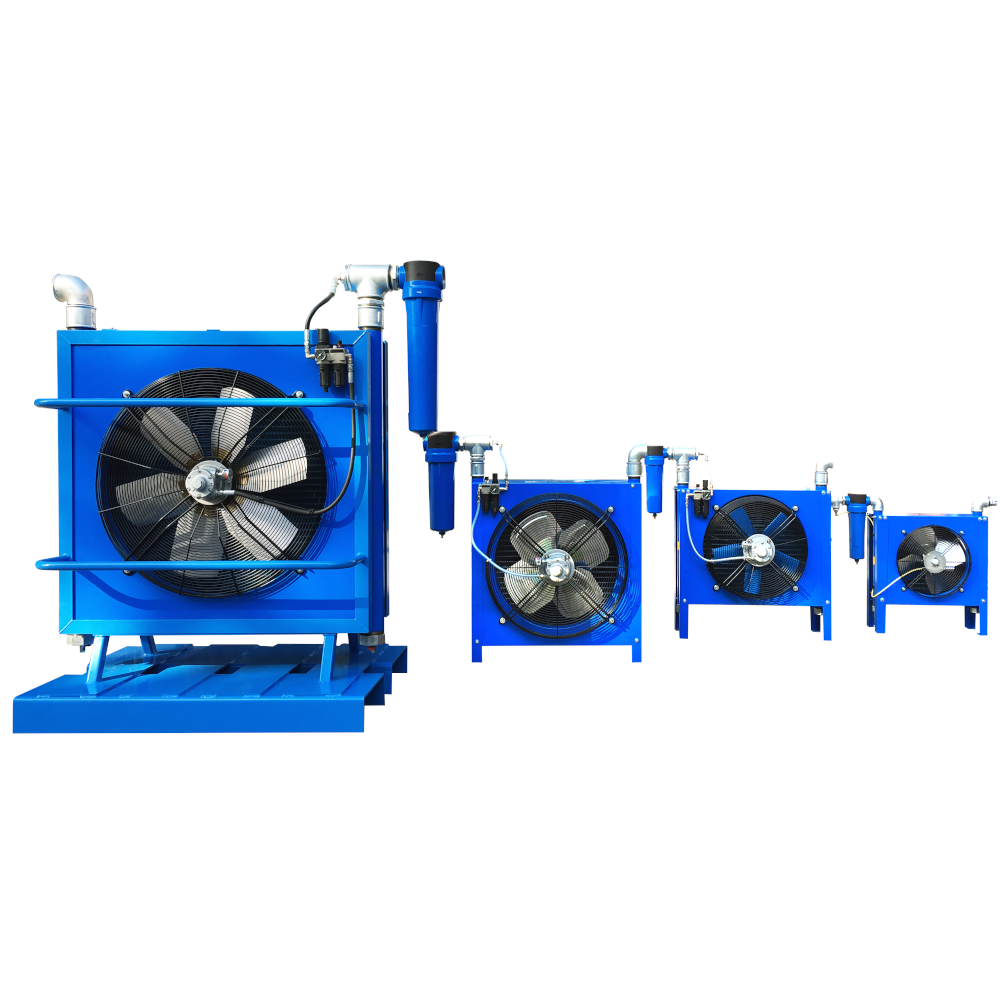
AIRPLUS® air aftercoolers ensure efficient cooling of compressed air at the compressor outlet. An integrated heat exchanger and motor-driven fan quickly reduce the air emperature, which can reach up to 70 °C after pressurization. This cooling below the dew point causes water vapor to condense into fine droplets, which are automatically removed by the built-in moisture separator.
 |
UsageThe air aftercooler is ideally installed close to the pneumatic tool, at the end of the line, and away from the compressor. |
How does it work?
The air aftercooler condenses water vapor and efficiently removes it via an integrated cyclone moisture separator. By generating a swirling flow, the separator projects the condensed water vapor onto its walls, from where it is then evacuated through the drain.
This process improves working conditions.
What are the Benefits?
- Pneumatic, no electricity required
- Simple to use and cost-effective
- Less effective than an air dryer
Moisture in Compressed Air: A Major Challenge in Blasting
During abrasive blasting operations using compressed air, moisture condensation is a critical issue. This natural phenomenon occurs due to the inevitable cooling of compressed air following its sharp temperature rise during pressurization by the compressor. To effectively resolve this, using an aftercooler or an air dryer is essential.
 |
Origin of HumidityAir drawn in by the compressor contains a variable amount of humidity depending on weather conditions. When pressurized, air temperature increases sharply. |
 |
Droplet FormationWhen pressure suddenly drops (e.g. when blasting starts or stops), the temperature drops as well. This causes water vapor to condense into droplets once the dew point is reached. |
|
Impact on BlastingThese droplets mix with the abrasive and form clumps that impair flow, affecting work consistency and performance. |
|
SolutionAftercoolers and air dryers cool compressed air and eliminate excess moisture before it enters the blaster — ensuring optimal performance and consistent media flow. |
Technical Specifications
| REFERENCE | |||||||
|---|---|---|---|---|---|---|---|
| Pneumatic | Electric | m³/h | L/min | CFM | Working Pressure Min / Max | Weight | ON FRAME |
| NC10P | NC10E | 60 | 1 000 | 35 | 8 bar / 16 bar | 18 kg |  |
| NC17P | NC17E | 120 | 2 000 | 71 | 8 bar / 16 bar | 19 kg | |
| NC100P | NC100E | 180 | 3 000 | 100 | 8 bar / 16 bar | 30 kg | |
| NC160P | NC160E | 300 | 5 000 | 175 | 8 bar / 16 bar | 49 kg | |
| NC250P | NC250E | 480 | 8 000 | 280 | 8 bar / 16 bar | 53 kg | |
| NC360P | NC360E | 720 | 12 000 | 420 | 8 bar / 16 bar | 97 kg | |
| NC560P | NC560E | 960 | 16 000 | 560 | 8 bar / 16 bar | 120 kg |  |
| NC700P | NC700E | 1 200 | 20 000 | 700 | 8 bar / 16 bar | 240 kg | |
| NC750P | NC750E | 1 500 | 25 000 | 880 | 8 bar / 16 bar | 250 kg | |
| NC1000E | 1 800 | 30 000 | 1 000 | 8 bar / 16 bar | 280 kg | |
|
| NC1750E | 3 000 | 50 000 | 1 750 | 8 bar / 16 bar | 310 kg | |
|
| NC2100E | 3 900 | 65 000 | 2 300 | 8 bar / 16 bar | 330 kg | |
|
| NC2800E | 4 500 | 75 000 | 2 600 | 8 bar / 16 bar | 350 kg | |
|