Reference:
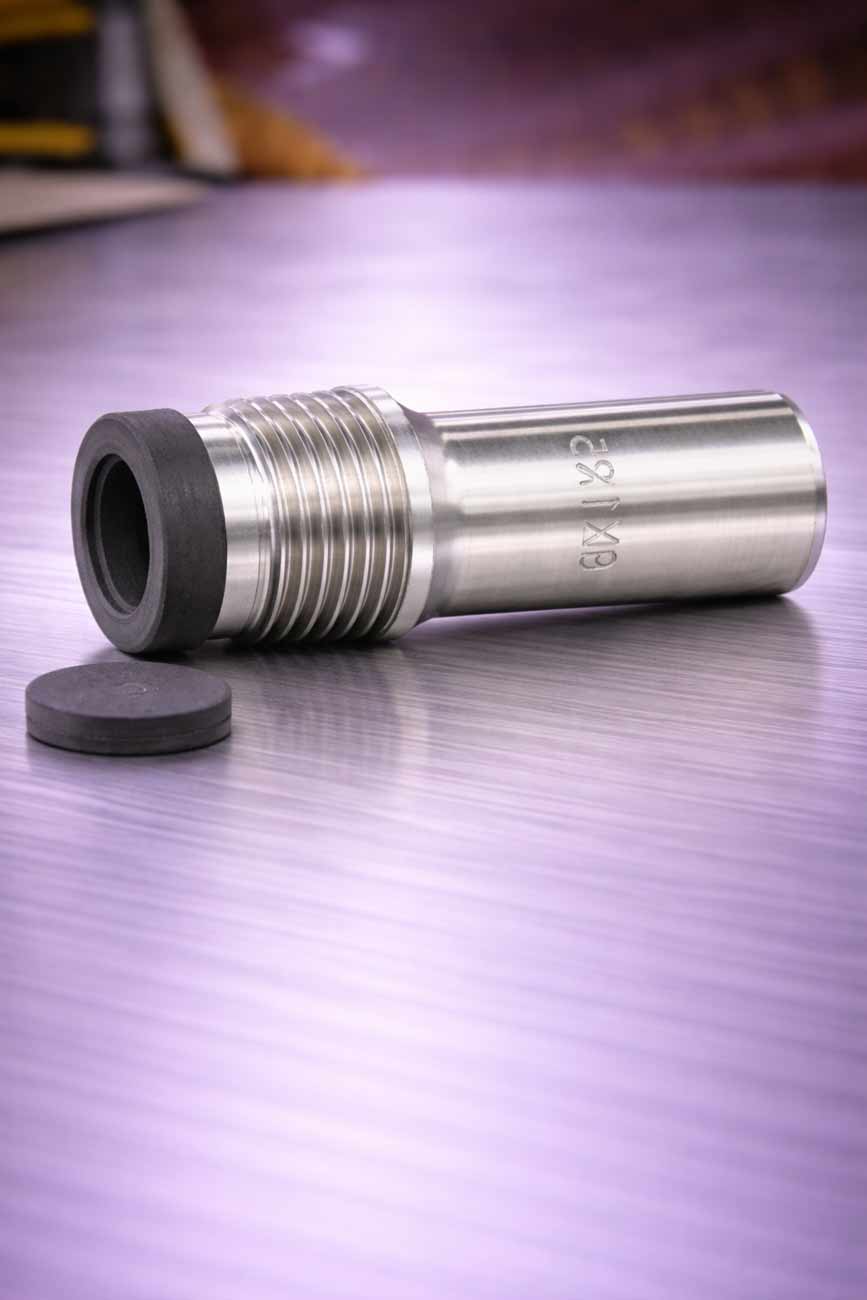
Tungsten carbide
Aluminium body. 50 mm coarse thread.
NX40
f
External Ø
3/16” / 4.8 mm
Length
85 mm
Internal Ø
1” / 25 mm
NX60
f
External Ø
1/4” / 6.3 mm
Length
85 mm
Internal Ø
1” 1/4” / 32 mm
NX80
f
External Ø
5/16” / 8.0 mm
Length
85 mm
Internal Ø
1” 1/4” / 32 mm
NX95
f
External Ø
3/8” / 9.5 mm
Length
85 mm
Internal Ø
1” 1/4” / 32 mm
NX110
f
External Ø
7/16” / 11.0 mm
Length
85 mm
Internal Ø
1” 1/4” / 32 mm
NX125
f
External Ø
1/2” / 12.5 mm
Length
85 mm
Internal Ø
1” 1/4” / 32 mm
Available on request with 1” inlet Ø, flange or 1″ 1/4 NPT thread.
To choose the ideal blasting nozzle, it is crucial to understand the variables affecting performance and costs. Make sure you address these 4 key points to optimise the cost/performance ratio.
The choice of nozzle depends on your compressor’s air flow. See pages 36 and 37 to discover our range of NORBLAST® compressors.
To maintain the compressor’s maximum pressure at the nozzle outlet, the compressor’s air flow must be greater than the air consumption of the chosen nozzle. If the flow is insufficient, the pressure at the nozzle outlet will drop, affecting output and productivity. To check the pressure, use the NOB4580 hypodermic pressure gauge. Determine the pressure required at the nozzle and your compressor’s air flow in m³/min (CFM), then see the table on p.39 to choose the appropriate nozzle size.

Uniform channel with no taper, easy to use and maintain. Cheaper, suited to small objects and jobs requiring less precision.

Converging shape at the inlet and diverging at the outlet. Increases the abrasive speed thanks to the venturi. Ideal for large surfaces.

Two sections for increased venturi efficiency. Increases output and productivity.

Designed for wet blasting or hydro-blasting, reducing dust while allowing delicate surfaces to be stripped.

Designed to maximise the abrasive speed. Reduces working time and energy consumption. Ideal for industrial applications requiring speed and efficiency despite its higher weight.

45° outlet to direct the abrasive towards hard-to-reach areas. Ideal for blasting corners, cavities and complex surfaces.

40° outlet to direct the abrasive towards hard-to-reach areas. Ideal for blasting corners, cavities and complex surfaces.
Tungsten carbide
Tungsten carbide nozzles are known for their durability and wear resistance. This material is ideal for intensive blasting applications where pressure and abrasion are high. Tungsten carbide offers excellent longevity and can withstand prolonged use with very hard abrasives. However, it can be heavier than other materials, which may be a factor to consider depending on the application.
Silicon nitride
Silicon nitride nozzles stand out for their exceptional wear resistance and ability to withstand high temperatures. This material is particularly suited to demanding blasting applications in extreme conditions. Silicon nitride is lightweight, offering a durable solution without the extra weight of other abrasion-resistant materials, while also withstanding high temperatures. Although often more expensive, these nozzles are an excellent choice for intensive, prolonged working environments. These nozzles are more sensitive to impacts than tungsten carbide.
Boron carbide
Boron carbide nozzles are renowned for being among the hardest and most wear-resistant available on the market. This material is extremely resistant to abrasion, making it an ideal choice for applications using very aggressive abrasives, particularly corundum. Although more expensive than other nozzle types, their exceptional longevity can justify the investment over the long term.
Nozzle material
Steel shot
Slag
Corundum
Tungsten carbide
500-800 h
300-400 h
20-40 h
Silicon nitride
1400-2000 h
700-1400 h
180-800 h
Boron carbide
1500-2500 h
750-2000 h
100-200 h
Estimated values in hours for comparison purposes. Actual service life may vary depending on multiple factors. These values are provided for guidance only.
Compressed air is the driving force of any blasting or soft-blasting operation. The flow of the compressor used must match the nozzle’s consumption, which is directly linked to its diameter. If the compressor’s flow is insufficient, the pressure will gradually drop, both in the blaster and at the nozzle. To maintain the maximum pressure delivered by the compressor, the flow must be at least equal to the consumption, and preferably higher.
On all blasting worksites, production output depends on the diameter of the nozzle used and the pressure at its outlet — maximum pressure can only be maintained if the compressor’s flow is sufficient to feed the nozzle in use. Check that the flow of the compressor used is sufficient for the nozzle; otherwise use a smaller-diameter nozzle or replace the compressor.
Nozzle Ø
Air, power and abrasive
Nozzle pressure (bar)
3.5
4.2
5.0
5.6
6.3
7.0
2.6 – 3/52
Air – m³/min
Abrasive – kg/h
Power – HP
0.22
23
2.5
0.26
27
2.5
0.3
30
2.5
0.34
33
3
0.37
36
3
0.4
38
3.5
3.2 – 1/8
Air – m³/min
Abrasive – kg/h
Power – HP
0.3
30
2.5
0.36
35
3
0.42
40
3.5
0,47
46
4
0.51
51
4.1
0,55
56
5
4.8 – 3/16
Air – m³/min
Abrasive – kg/h
Power – HP
0.72
68
6
0.83
78
7
0.92
89
8
1.05
98
9
1.14
108
10
1.25
120
10
6.3 – 1/4
Air – m³/min
Abrasive – kg/h
Power – HP
1.3
122
10
1.5
142
12
1.7
161
14
1.09
185
15
2.1
204
16
2.5
239
18
8.0 – 5/16
Air – m³/min
Abrasive – kg/h
Power – HP
2.2
213
18
2.5
243
20
2.9
275
22
3.3
305
25
3.6
336
28
4.2
409
30
9.5 – 3/8
Air – m³/min
Abrasive – kg/h
Power – HP
3.0
303
24
3.6
348
28
4.0
393
32
4.6
436
36
5.0
478
39
5.6
545
44
11.0 – 7/16
Air – m³/min
Abrasive – kg/h
Power – HP
4.1
407
33
4.8
469
38
5.5
535
44
6.1
596
49
6.8
522
54
7.4
750
57
12.7 – 1/2
Air – m³/min
Abrasive – kg/h
Power – HP
5.5
527
44
6.3
607
50
7.1
687
56
7.9
764
63
8.8
844
69
9.9
1000
75
This table is provided for guidance. The performances mentioned may vary according to actual conditions of use.

Made in France in our workshops in Haute-Savoie

After-sales service for overhauls and maintenance

Designed for rental with rugged machines and reinforced components. Simple start-up.

Immediate profitability: fast ROI from the very first rentals. Pricing tailored to professionals.

Easy to maintain with easy access to wear parts and simplified maintenance.
Complete support: hands-on training, rental info sheets ready to hand to the customer. Responsive after-sales service, spare parts available.
A question, an idea or in need of advice?
Leave us your contact details and your sales rep will call you back shortly to discuss it.
Privacy
We use cookies necessary for the site to work and, with your consent, audience measurement, marketing and external content tools. Read the cookie policy.
You can accept or reject the non-essential categories. Your choice is kept for 6 months and can be changed via the “Cookie Settings” link at the bottom of the page.
Essential for the security, display and basic functions of the site. They always remain active.
Jetpack Stats and WooCommerce Analytics help us understand visits and how the site is used.
Brevo and WonderPush may be used for marketing tracking, notifications or customer relations.
YouTube and some social services may set trackers when you display or use their content.